
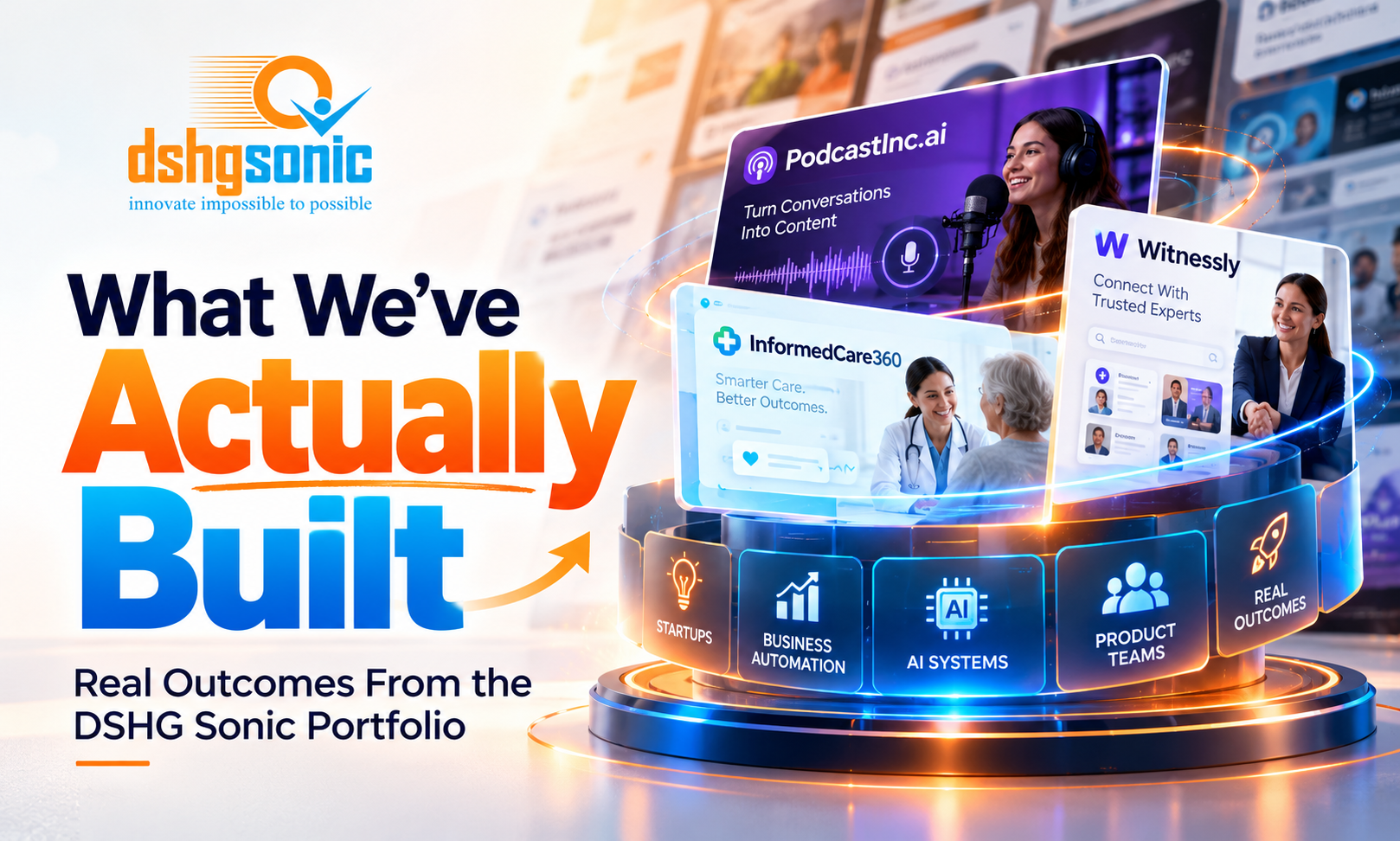
What We've Built: Real Results From DSHG Sonic's Portfolio
What We’ve Actually Built: Real Outcomes From the DSHG Sonic Portfolio

Manish Balakrishnan
Manish is the Founder and CEO of DSHG Sonic and specializes in helping founders validate startup ideas through market research, customer discovery, and strategic analysis. He believes that strong validation is the foundation of successful startups and guides entrepreneurs in identifying product-market fit before scaling.
"ee what DSHG Sonic has actually built across AI systems, startups, healthcare, marketplaces, and automation—and the real outcomes behind our portfolio."
A portfolio should do more than prove that a software studio knows how to write code. The more useful question is: What kinds of problems has the team actually solved?
At DSHG Sonic, our work spans founder-led startups, AI-native products, operating-business systems, marketplaces, healthcare platforms, media technology, and workflow-heavy applications. The products are different, but the underlying work has a common thread: turning an idea, business problem, or complicated workflow into a system people can actually use.
That distinction matters. A polished prototype can look impressive in a demo. A production product has to deal with authentication, permissions, infrastructure, data, integrations, AI reliability, admin controls, edge cases, user behavior, deployment, and all the less glamorous engineering that determines whether software survives outside a presentation.
That is why we think the best way to understand DSHG Sonic is not through a list of technologies. It is through the products and outcomes behind the DSHG Sonic portfolio.
We Build Across Three Different Problems
Not every company comes to us at the same stage. Some founders arrive with an idea and need to turn it into a real product. Some operating businesses already have revenue and customers but are losing time or money through disconnected systems and manual processes. Other companies already have products and engineering teams but need senior technical leadership or specialized AI engineering.
Through our startup co-build model, we work with founders who need to decide what the MVP actually needs to prove and then get that product into users' hands. For operating businesses, the challenge may be identifying where AI and automation can reduce repetitive work, improve response time, or connect systems that were never designed to communicate. For established product teams, the need may be architecture, AI implementation, infrastructure, integrations, or technical leadership.
Those require different kinds of work. That range is why DSHG Sonic operates more like a studio than a conventional development shop.
PodcastInc.ai: Building Around an AI-Native Media Workflow
Podcasting looks simple from the outside: record something, publish it, and promote it. The software behind a serious podcast platform is more complicated. Media products have to deal with content workflows, user experience, AI processing, publishing-related functionality, and the operational steps surrounding the content itself.
PodcastInc.ai represents the kind of product where AI is not simply added as a chatbot sitting beside an existing application. It becomes part of the workflow. That distinction matters because one of the patterns we have seen repeatedly is that AI creates more value when it is embedded into something a user is already trying to accomplish.
The question is not, "Where can we put AI?" It is, "Which part of this workflow becomes meaningfully faster or better because AI is involved?"
A useful AI feature needs the surrounding software that makes it operational: user accounts, data flow, permissions, model interactions, validation, storage, interfaces, error handling, and the ability to observe what happens after the system is released. The model may generate the impressive part. The engineering around it is what turns that capability into a product.
InformedCare360: AI Where Reliability Matters More Than Novelty
Healthcare-related products change the engineering conversation. An AI system used for entertainment can tolerate behaviors that would be unacceptable in a workflow involving sensitive information. As the consequence of an incorrect output increases, so does the importance of guardrails, validation, permissions, source control, and human review.
Work involving platforms such as InformedCare360 reinforces an important principle: AI should not be given more authority simply because it is capable of generating an answer. The architecture has to determine what the system is allowed to do.
That means thinking about what information the model can access, what happens when the available information does not support an answer, which actions can happen automatically, when the system should stop, when a human should take over, how actions or outputs are recorded, and how sensitive information moves through the system.
These questions are not separate from AI engineering. They become part of AI engineering once a system moves into production. This is one reason DSHG Sonic's approach to AI systems focuses on the complete operating environment around a model rather than treating a prompt as the finished product.
Witnessly: Building a Marketplace Means Building Trust
Marketplaces present a different product challenge. The software has to serve multiple sides of a transaction. A marketplace may need profiles, discovery, matching, communication, administrative oversight, permissions, and workflows that move users from initial interest toward a completed engagement.
But the technical workflow is only part of the problem. A marketplace has to create enough structure for people who do not already know one another to interact confidently. That changes product decisions: what information belongs on a profile, what one user needs to know before engaging another, what administrators should control, and what happens when something falls outside the normal workflow.
Witnessly, an expert marketplace within the DSHG Sonic portfolio, represents this kind of multi-sided product thinking. It also illustrates why building an MVP is not just a matter of reducing the number of features. A useful marketplace MVP has to preserve enough of the core transaction to test whether the marketplace itself works.
Remove too much and you are no longer testing the business. Build too much and you spend months creating infrastructure around assumptions that have not been validated. That balance between speed and meaningful validation is one of the central problems in a startup co-build.
What These Products Have Taught Us About MVPs
The word MVP is frequently interpreted as a smaller version of the final application. That is not how we think about it. An MVP should be the smallest credible product that allows the company to learn something important.
Suppose a founder ultimately imagines a platform containing mobile applications, sophisticated AI, multiple user roles, automated workflows, analytics, integrations, and a marketplace. The first release may need only a fraction of those capabilities.
The question is not how many features can fit into version one. The question is what version one needs to prove. Maybe the company needs to prove that users will complete the core workflow. Maybe it needs to prove that customers will pay. Maybe it needs to determine whether AI can perform a particular task reliably enough to create value. Maybe it needs enough functionality for a customer pilot or real usage evidence before fundraising.
Once that objective is clear, product decisions become easier. Features either help create the evidence the company needs or they do not.
The Real Work Starts After "Can We Build It?"
Modern software development has made it easier than ever to demonstrate an idea. AI has accelerated that even further. A small team can build an interface, connect an LLM, generate convincing outputs, and produce something that looks surprisingly complete in a short period of time.
That has shifted the difficult question. It is often no longer: Can this be built? It is: Can this operate reliably?
Production software needs to handle the parts a prototype can ignore: authentication, user permissions, data storage, security, infrastructure, logging, failures, integrations, admin controls, analytics, deployment, and recovery. For AI products, add model failures, hallucinations, prompt injection, structured-output validation, latency, token cost, fallback behavior, human escalation, model changes, and sensitive-data handling.
That is why DSHG Sonic's custom AI engineering work extends beyond connecting an application to a model API.
AI Should Have a Job, Not Just a Place in the Product
Another lesson from building AI products is that AI-powered is not a useful product requirement. AI needs a job. Maybe that job is extracting structured information from documents, helping a user search a knowledge base, qualifying an inbound lead, summarizing information for a human decision-maker, creating a first draft, routing a request, or performing several bounded actions as an agent.
Once the job is defined, we can decide how much autonomy the AI actually needs. Not every workflow should become an autonomous agent. Sometimes a deterministic automation is safer and faster. Sometimes AI should recommend an action but a person should approve it. Sometimes the system can execute independently because the consequence of an error is small and easily reversible.
The architecture should reflect the risk of the task. That is a much more useful framework than asking whether a company uses AI.
Building for Businesses Is Different From Building Startups
Portfolio work has also reinforced another distinction: building software for an existing business is fundamentally different from building a startup from zero. A startup begins with uncertainty. An operating business usually begins with an existing process.
There may already be employees answering phones, moving information between systems, preparing quotes, following up with customers, processing documents, or updating spreadsheets. That means we can observe the current workflow before deciding what to automate.
Where does the work begin? Where does information move? Where does someone have to make a decision? Where does the process stop? Where is information entered twice? Where do customers wait? Where does revenue leak? Once those points are visible, AI can be applied much more deliberately.
The result may be an AI receptionist, workflow automation, document-processing system, internal copilot, lead-response system, or agent. But the technology comes second. The business problem comes first.
Sometimes the Software Has No API
Real companies do not always operate on modern software stacks. A business may depend on a platform that has been used for ten years and has no public API. Employees may manually move information between that system, email, spreadsheets, scheduling software, and other applications.
Replacing the entire legacy system may be expensive, disruptive, and unnecessary. Depending on the software and what access is permitted, an automation may use exports and imports, email triggers, database access, browser automation, or a lightweight layer around the legacy system.
This is much less glamorous than an AI demo. It is also where significant business value can be created. If an employee spends hours every week transferring information because two systems cannot communicate, solving that problem can have a clearer economic impact than adding another visible AI feature.
Portfolio Work Changes How We Think About Architecture
Every product creates technical decisions. Some are easy to reverse. Others become expensive. A startup moving quickly should not architect version one as if it already has millions of users. But moving quickly does not mean ignoring every future consequence.
The objective is to identify which decisions need durability and which can remain flexible. That includes infrastructure, database structure, permissions, integrations, model providers, application architecture, and the boundaries between different services.
AI makes this especially important because the model landscape changes quickly. A product should not become unnecessarily dependent on one model when multiple providers could perform the job. At the same time, abstraction for its own sake can create complexity. Good architecture is not about predicting every future requirement. It is about keeping the right options open.
From Building Products to Providing Technical Leadership
Sometimes the highest-value contribution is not another developer. It is someone making the technical decisions.
A growing product company may already have capable engineers but lack a senior technical leader who owns architecture, infrastructure, AI strategy, vendor decisions, security priorities, and the relationship between the product roadmap and engineering roadmap.
That is where Fractional CTO support fits. Portfolio experience matters here because technical leadership improves when it comes from repeatedly seeing how decisions behave after launch. Architecture diagrams can look perfect. Production reveals what matters.
The Portfolio Is Also a Record of What We Would Do Differently
A portfolio should not only represent successes. Every product creates lessons. Some features were more complicated than expected. Some assumptions changed after users interacted with the product. Some integrations created unexpected constraints. Some architecture decisions became more important later. Some things that seemed essential during planning mattered much less after launch.
That experience changes how the next product is scoped. It makes the team more skeptical of unnecessary complexity. It makes measurement more important. It makes ownership and infrastructure access something to establish early rather than during handoff. It makes AI guardrails part of architecture rather than something added after a model behaves badly. And it reinforces the importance of building around outcomes instead of feature counts.
What Does "Outcome" Actually Mean?
Not every product should be judged by the same metric. For an early-stage startup, an outcome might be reaching a working MVP quickly enough to test the business thesis. For an operating company, it may be reducing administrative work, improving lead response, or automating a repetitive workflow. For a funded product team, it may be shipping a new AI capability without distracting the internal engineering organization. For a founder preparing to raise capital, it may be getting from slides to a credible working product with real usage evidence.
This is also why DSHG Sonic supports multiple commercial models rather than forcing every engagement into the same contract structure.
A defined build may make sense as fixed fee. Continuous technical leadership may make sense as a retainer. A selected early-stage startup may make sense as a cash + equity co-build. A measurable business automation may create an opportunity for an outcome-based structure. The engagement should reflect the problem.
What We've Actually Built Is More Important Than What We Say We Can Build
It is easy for a technology company to create a long capabilities list: AI agents, LLMs, mobile applications, web platforms, cloud infrastructure, computer vision, automation, marketplaces, and integrations. Those capabilities matter, but they are not the most useful evidence.
The more useful evidence is what happens when those technologies have to work together inside an actual product. Can the team take an ambiguous founder idea and turn it into an MVP? Can it build AI into a workflow without pretending the model is infallible? Can it create systems for different kinds of users? Can it work around legacy software? Can it continue supporting the product after launch? Can it make technical decisions that reflect the business rather than simply the technology?
That is what a portfolio should answer. DSHG Sonic's work across products including PodcastInc.ai, InformedCare360, Witnessly, and other founder and business initiatives represents more than a collection of applications. It represents accumulated product, engineering, AI, and operating experience.
The products are different. The underlying job remains remarkably consistent: understand the real problem, build only what needs to exist, make the technology work in the real world, and learn from what happens next.
That is what we have actually built - and, more importantly, what building those products has taught us.
Frequently Asked Questions
What kinds of products does DSHG Sonic build?
DSHG Sonic works across founder-led startups, AI-native products, business automation, marketplaces, workflow systems, and existing product teams requiring custom engineering or technical leadership.
Does DSHG Sonic only work with startups?
No. The studio model supports early-stage founders as well as operating businesses and funded product teams. The engagement structure changes depending on the problem.
Does every DSHG Sonic project use AI?
No. AI is used when it creates meaningful leverage. Some problems are better solved with conventional software, integrations, deterministic automation, or a combination of those technologies.
Can DSHG Sonic continue working with a company after launch?
Yes. Depending on the engagement, continued work can include product engineering, custom AI development, technical operations, or Fractional CTO support.
Where can I see DSHG Sonic's work?
The DSHG Sonic portfolio contains examples of products and companies the studio has supported.