
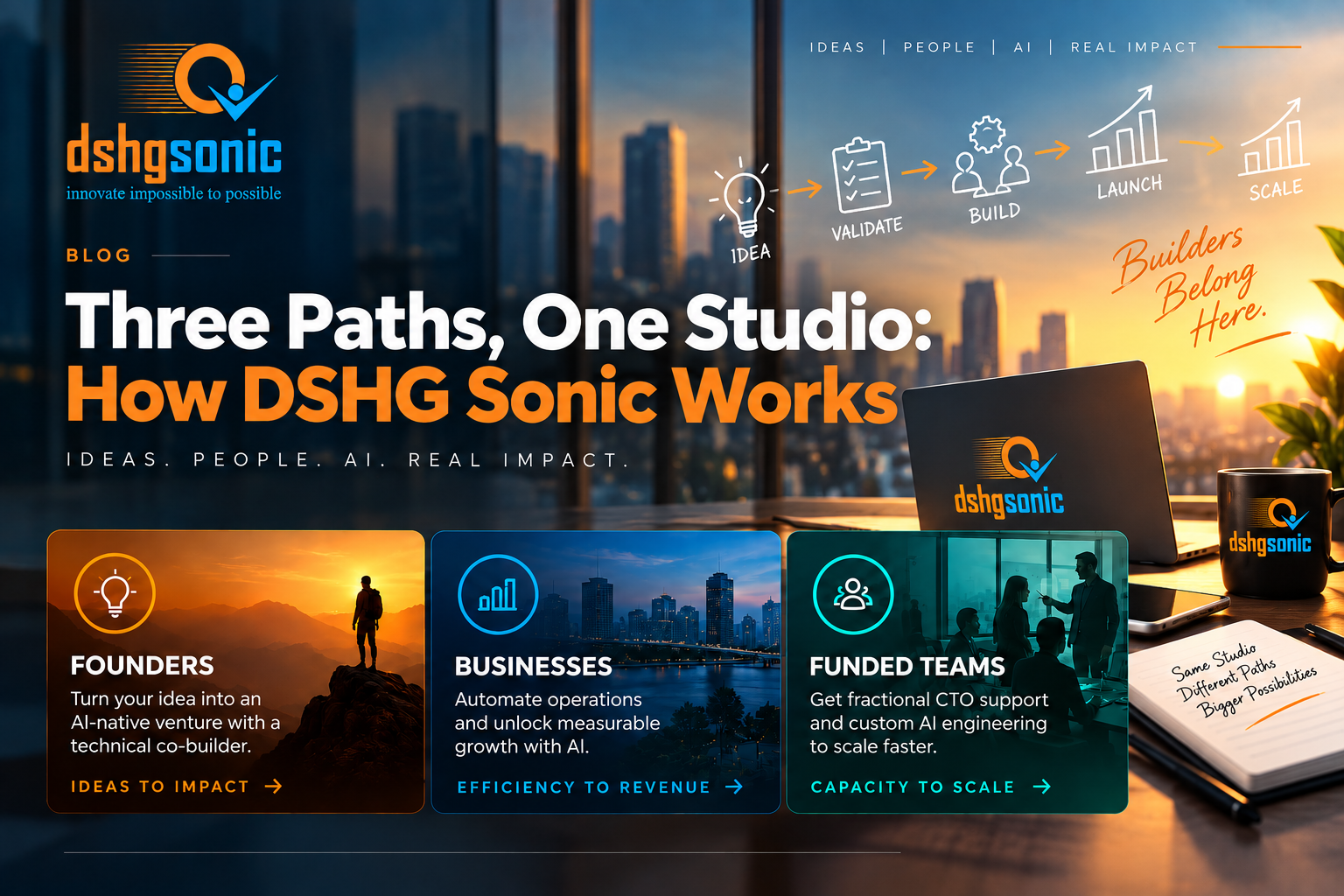
Three Paths, One Studio: How DSHG Sonic Works

Manish Balakrishnan
Manish is the Founder and CEO of DSHG Sonic and specializes in helping founders validate startup ideas through market research, customer discovery, and strategic analysis. He believes that strong validation is the foundation of successful startups and guides entrepreneurs in identifying product-market fit before scaling.
"DSHG Sonic supports three paths: startup co-building for founders, AI outcome systems for growing businesses, and Fractional CTO/custom engineering for funded teams."
The phrase “software company” hides an important reality: the same engineering team can be asked to solve completely different kinds of problems.
An early-stage founder may need to turn an idea into a launchable MVP.
A growing business may already have customers and revenue but lose time and money through manual workflows, missed calls, slow follow-up, and disconnected systems.
A funded startup may already have developers and a product in market but need senior technical leadership, custom AI engineering, or additional product capacity.
Those clients should not be forced through the same process.
DSHG Sonic is structured around three paths: build a startup, automate a business, or extend a product team. The underlying capabilities overlap—product strategy, software engineering, AI, automation, architecture, and technical leadership—but the engagement begins from a different problem.
This article explains how the three paths work, what each is designed to accomplish, and how to decide where you fit.
Path 1: Build My Startup
The first path is for founders.
The founder may have deep domain knowledge, customer access, a business thesis, or a clear problem worth solving, but no technical cofounder or internal engineering organization.
The immediate temptation is to turn the idea into a feature list.
We prefer to start one level earlier: what does the first product need to prove?
That question changes the build.
A founder may imagine a platform with ten user roles, advanced AI, mobile apps, dashboards, integrations, and a marketplace. But if the first business assumption is whether one customer segment will pay for one workflow, most of that scope may delay the learning that matters.
The startup path therefore combines product scoping with engineering.
What DSHG Sonic can do for founders
The work can include MVP definition, UX and product planning, full-stack development, AI integration, architecture, cloud deployment, admin systems, analytics, launch support, and continued technical involvement.
For selected startups, DSHG Sonic can structure the relationship as a cash + equity co-build. That model is designed for alignment: the studio accepts part of its compensation as ownership and therefore participates in the venture risk.
The goal is not to become a permanent outsourced engineering department. The goal is to help the founder reach the next meaningful stage: a working product, real users, customer evidence, revenue, fundraising readiness, or the point where an internal team makes sense.
What founders still own
A studio cannot outsource founder responsibility.
The founder still owns the customer problem, market learning, sales, distribution, fundraising, and company vision. The studio can challenge assumptions and help translate learning into product decisions, but it cannot create conviction or customer demand on the founder’s behalf.
The strongest co-builds happen when both sides bring something essential.
The founder brings market context and commitment. The studio brings product and technical execution.
Path 2: Automate My Business
The second path is for operating businesses.
These companies are not asking, “Can you build my startup?” They are asking, “Where can AI and automation create measurable leverage in the business we already have?”
The answer is rarely a generic chatbot.
The best opportunities are usually hidden in repetitive workflows: missed inbound calls, slow lead response, manual scheduling, quote preparation, document processing, status updates, data entry, internal handoffs, repetitive support, or employees moving information between systems.
We call these AI outcome systems because the project begins with the business outcome.
Start with the operating metric
A business should know what it wants to change.
Reduce missed opportunities. Respond to every lead within minutes. Save administrative hours. Shorten the time from inquiry to quote. Increase appointment booking. Reduce repetitive data entry. Improve follow-up consistency.
Once the target is clear, the technology can be designed around it.
The system may include an AI receptionist, workflow automation, an agent, a copilot, integrations, document extraction, messaging, or browser automation for legacy software.
AI is not the product requirement. The business outcome is.
What about businesses with old software?
Many growing companies rely on legacy systems that have no public API.
That does not automatically make automation impossible.
The integration may use exports and imports, email triggers, vendor-supported database access, browser automation, or a new workflow layer that sits around the legacy application.
The design should prefer stable supported interfaces when they exist. Screen automation is useful when necessary, but it needs monitoring because interfaces change.
The point is to meet the business where it operates instead of requiring a complete software replacement before any automation can begin.
Fixed fee or outcome-based
Business automation can be structured in different ways.
A clearly defined system may be built for a fixed fee. Ongoing automation and optimization may use a retainer. When a baseline and business result can be measured fairly, an outcome-based structure may also be possible.
The commercial model should match the certainty of the work and the measurability of the result.
Path 3: Extend My Product Team
The third path is for funded startups and growing product companies.
These teams often already have engineers. Their problem is not “we have nobody technical.” Their problem is capacity, specialization, or leadership.
They may need a Fractional CTO to own architecture and technical strategy. They may need custom AI engineers to add an AI layer to an existing product. They may need a product pod to accelerate a roadmap. They may need help stabilizing infrastructure, evaluating vendors, improving release processes, or governing AI agents.
The engagement should fit around the existing team rather than compete with it.
Fractional CTO: leadership without a full-time executive hire
A Fractional CTO provides senior technical leadership on a part-time or embedded basis.
The work may include architecture, roadmap decisions, engineering management, technical hiring, infrastructure strategy, security, vendor selection, AI governance, or translating business goals into technical priorities.
This is particularly useful when the company has developers but lacks a senior person accountable for the whole technical picture.
A good Fractional CTO reduces decision debt.
The company stops making isolated choices about frameworks, vendors, AI tools, and infrastructure without understanding how they fit together.
Custom AI engineering: execution for defined product needs
A funded team may already know what it wants to build.
It may need an LLM workflow, retrieval system, AI agent, voice feature, document-processing pipeline, computer-vision component, model orchestration layer, or integration between AI and the existing product.
That is a custom engineering problem.
The work should be production-minded. Models need evaluation. Outputs need validation. Agents need permissions. Sensitive workflows need human review. Systems need logs, fallbacks, and cost controls.
The goal is not to bolt a model onto the product. It is to add AI in a way that survives real users and real operational conditions.
One studio, different engagement models
The three paths also map to different commercial structures.
A founder may use cash + equity because the studio is sharing venture risk.
A business may use fixed fee for a defined automation or outcome-based pricing when the result can be measured.
A funded team may use a Fractional CTO retainer or a fixed/custom engineering engagement.
DSHG Sonic also uses standard retainers when ongoing work and changing priorities make a recurring relationship more practical.
The model is chosen after understanding the problem.
Why keep the paths under one studio?
Because the capabilities reinforce one another.
Startup work teaches speed, product judgment, and how to build under uncertainty.
Business automation teaches operational discipline and forces AI to prove itself against real economic outcomes.
Funded-team work creates deeper architecture, governance, and scale experience.
Those lessons compound.
A startup may eventually become a funded product team. A business automation may evolve into a software product. A Fractional CTO engagement may reveal an opportunity for a custom AI system.
Keeping the capabilities together makes it easier to follow the client’s stage rather than hand the relationship off every time the problem changes.
Examples of the kinds of products a studio can support
The value of a portfolio is not the number of logos. It is the range of problems the team has had to solve.
A podcast platform creates different product and AI challenges than a care-intelligence platform. A marketplace creates different trust and workflow requirements than an internal automation. A founder MVP creates different constraints than a mature operating business.
The common thread is turning a business problem into a technical system that can operate in the real world.
How the process works across all three paths
Although the starting point changes, the operating process has a common shape.
1. Diagnose
Understand the company, user, workflow, technical environment, and desired outcome.
For a founder, diagnosis focuses on the business thesis and MVP assumptions. For a business, it focuses on operational bottlenecks and measurable leakage. For a funded team, it focuses on architecture, roadmap, capacity, and leadership gaps.
2. Design
Map the product, automation, or technical plan.
This includes the user flow, data flow, AI behavior, integrations, permissions, infrastructure, and measurement plan.
3. Build
Develop the system using the appropriate mix of conventional software and AI.
Model-neutrality matters here. Different tasks may be better served by different models or providers. The architecture should avoid unnecessary lock-in when practical.
4. Launch
Deploy into the real environment, test edge cases, observe behavior, and measure what changed.
A launch is not complete because the code reached production. It is complete when the system is operating with real users or real workflows.
5. Scale
Improve the system based on evidence.
That may mean deeper automation, better AI evaluation, new features, more integrations, an internal engineering team, or a new commercial structure.
How do you know which path you are on?
Ask what is missing today.
If you have a company idea but no product or technical team, you are probably on the startup path.
If you have an operating business and want to reduce manual work or capture more revenue, you are probably on the AI outcome path.
If you have a product and team but need senior leadership, specialized AI engineering, or additional capacity, you are probably on the product-team path.
Some companies sit between categories. That is normal.
A founder with a launched product may need Fractional CTO support. A business may decide to turn an internal automation into a standalone product. A funded startup may need a studio-style product sprint for a new venture.
The paths are entry points, not boxes.
What DSHG Sonic is not
It is not useful to describe every technical firm by what it claims to be. It is more useful to describe what the operating model is designed to avoid.
The studio is not intended to sell AI demos with no connection to a business result. It is not designed around one model vendor. It is not limited to startups. It is not only staff augmentation. And it is not a venture model that requires every client to give up equity.
Different clients need different relationships.
That flexibility is the point of the three-path structure.
Questions to ask before choosing a partner
Regardless of the path, ask who owns the outcome.
Who is responsible for architecture? Who manages the developers? Who controls cloud accounts? Who owns the code? What happens after launch? How are AI failures handled? What data can be sent to third-party models? How is success measured? What happens when scope changes?
A partner should be able to answer those questions without hiding behind a service label.
Final takeaway
DSHG Sonic works through three primary paths because founders, growing businesses, and funded product teams start with different problems.
Founders need a path from idea to product and, in selected cases, a cash + equity technical co-builder.
Growing businesses need AI systems that reduce manual work, improve response, recover revenue, and connect fragmented operations.
Funded teams need senior technical leadership, custom AI engineering, and additional product capacity without rebuilding their organization from scratch.
The capabilities overlap, but the objective comes first.
Build the startup. Automate the business. Extend the product team.
Three paths, one studio—and a commercial model designed around the work rather than forcing the work into a single template.
Frequently asked questions
Does every DSHG Sonic client give up equity? No. Equity is relevant to selected startup co-builds. Fixed-fee, retainer, and outcome-based structures are also used depending on the engagement.
Can an existing business work with DSHG Sonic without building a new app? Yes. Many AI outcome systems are designed around existing workflows and software.
Can DSHG Sonic work with an existing engineering team? Yes. Fractional CTO and custom AI engineering engagements can extend an existing product organization.
What if we are not sure which path fits? Start with the business or technical gap you need to close. The appropriate path and commercial model can be selected from there.