
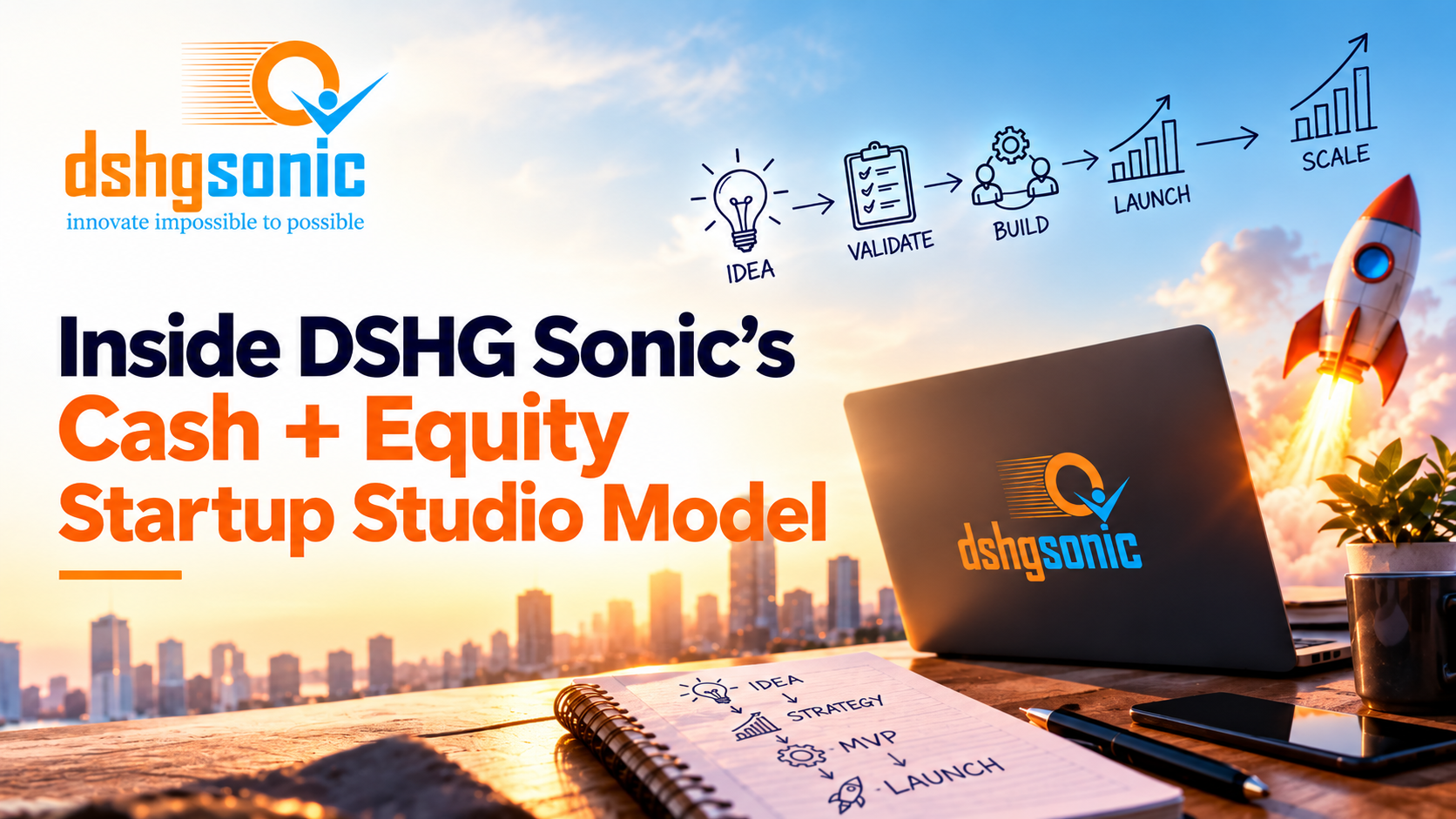
Inside DSHG Sonic's Cash + Equity Startup Studio Model

Manish Balakrishnan
Manish is the Founder and CEO of DSHG Sonic and specializes in helping founders validate startup ideas through market research, customer discovery, and strategic analysis. He believes that strong validation is the foundation of successful startups and guides entrepreneurs in identifying product-market fit before scaling.
"A practical guide to cash + equity startup studio partnerships, from founder fit and MVP scoping to ownership, launch, iteration, and long-term alignment."
There is a difficult stage in a startup before the product exists but after the idea has become too serious to remain a side project.
The founder has a problem worth solving, a point of view about the market, and enough conviction to start. But there may be no technical cofounder, no engineering team, no product architecture, and no clear answer to the question: what exactly should we build first?
Traditional outsourcing solves part of that problem. A founder can hire an agency, describe the product, pay for development, and receive software.
At DSHG Sonic, selected early-stage engagements can use a cash + equity model. The founder pays part of the build cost in cash, while the studio takes equity for the remaining portion. The purpose is not simply to make development cheaper. It is to align incentives so the studio has exposure to what happens after the first release.
This article explains what that model means in practice, how the journey from idea to launch changes, and what founders should understand before exchanging equity for a technical partnership.
What is a cash + equity startup studio model?
A cash + equity model combines a normal commercial payment with ownership in the startup.
Instead of the founder paying the entire build cost in cash, the studio accepts a portion of its compensation as equity. In return, the studio takes venture risk: the equity may become valuable, or it may become worth nothing.
That risk changes the relationship.
A traditional vendor can succeed by delivering the agreed scope. A studio holding equity has a reason to care about whether the scope is the right one, whether the product can reach users, whether the architecture can support the next stage, and whether the founder is building a company that has a realistic chance to create value.
This does not eliminate the need for contracts, scope, milestones, or accountability. It adds another layer of alignment.
Stage 1: deciding whether the partnership fits
The first step should not be writing code.
A studio co-build requires mutual selection. The founder is deciding whether to trust a technical partner with an important part of the company. The studio is deciding whether to invest time, engineering capacity, and equity risk into the founder’s thesis.
The discussion should cover the problem, customer, market, founder commitment, competitive landscape, business model, current evidence, and what needs to be true for the first version to matter.
The founder does not need to have every answer. Early-stage companies are uncertain by definition. But there should be enough substance to distinguish a venture from a feature idea.
At this stage, a good studio should also be willing to say that the product is too broad, too early, or not yet ready for a co-build.
Stage 2: turning the idea into an MVP thesis
Founders often arrive with a product vision that contains several years of features.
The job of MVP scoping is to identify the smallest product that can test the most important assumptions.
That is not the same as building a cheap version of the final product.
A useful MVP answers questions. Will the target user care? Will they complete the core workflow? Can the business acquire them? Does the proposed AI behavior create enough value? Will customers trust the system? Is the operational model workable?
Every feature that does not help answer a critical question deserves scrutiny.
This is where a studio relationship can be valuable. The team is not rewarded for maximizing the feature list. It should be rewarded for helping the company reach useful evidence quickly.
Stage 3: product and technical architecture
Once the MVP thesis is clear, the team turns it into a product and technical plan.
That includes user roles, workflows, data model, integrations, AI components, security requirements, infrastructure, admin capabilities, and the boundaries of the first release.
The fastest way to build an AI demo is to connect a model to an interface. The harder and more important work is making the behavior reliable enough for real users.
A studio should make those tradeoffs visible to the founder. Where are we moving fast? Where are we deliberately adding control? Which decisions can be postponed? Which decisions become expensive if made badly now?
Stage 4: building in short feedback loops
The founder should not disappear for three months and return for a reveal.
A co-build works best when the founder stays close to the product. Frequent demonstrations, decisions, and feedback keep the build connected to the business thesis.
This does not mean the founder should manage developers task by task. It means the founder remains the source of customer and market context while the studio owns technical execution.
The rhythm should make uncertainty visible early.
If a workflow is confusing, discover that in week two, not at launch. If an AI feature is unreliable, test it before the rest of the product depends on it. If an integration has constraints, surface them before they become a critical path.
Speed comes from shortening feedback loops, not merely writing code faster.
Stage 5: launch is an experiment, not a graduation ceremony
The first release is where assumptions meet reality.
Users will behave differently than expected. Features that seemed essential may be ignored. A simple workflow may become the reason customers stay. A technical edge case may appear only after real data arrives.
The launch plan should therefore include measurement.
Which users activated? Where did they stop? Which actions correlate with value? What did support conversations reveal? Which AI outputs were corrected by humans? Which features created operational burden?
The first version creates information. The next roadmap should be based on that information rather than the original pitch deck.
What happens after launch?
This is one of the most important questions to ask before choosing a studio.
A startup rarely needs zero technical work after version one. It needs iteration, bug fixes, analytics, infrastructure, security improvements, new integrations, and decisions about what to build next.
The relationship can continue in different forms. The studio may remain involved through a retainer, ongoing product engineering, Fractional CTO support, or another agreed structure. The company may eventually hire its own internal team. The studio may support that transition.
A healthy co-build should make the startup less dependent over time, not trap it.
What about IP ownership?
The founder should understand IP ownership before development starts.
The agreement should distinguish product-specific intellectual property from pre-existing studio tools, reusable frameworks, open-source components, and third-party services.
The existence of an equity relationship does not make this less important. It makes clarity more important.
Founders should know what the company owns, what licenses it depends on, where source code is stored, who controls infrastructure accounts, and how access is transferred as the company grows.
Why would a studio take equity?
Because the studio believes its contribution can create value beyond the initial build.
Equity allows the studio to participate in that upside. It can also make deeper involvement economically rational when the startup cannot pay the full cash cost of senior product and engineering work at the earliest stage.
But equity is not free labor.
The studio is exchanging certain cash today for uncertain value later. That means it should be selective, and the founder should expect the studio to care about decisions that affect the company’s probability of success.
That can create productive tension. A founder may want a feature because a competitor has it. The studio may argue that the feature does not test the next business assumption. Because both sides have exposure to the company, the conversation is not merely “the client asked for it.”
Why would a founder give up equity?
Because capital and execution are both scarce.
A founder may decide that preserving cash, accelerating launch, gaining experienced technical leadership, and aligning with a long-term product partner is worth more than retaining that portion of ownership.
The calculation depends on the founder’s alternatives.
If the founder can easily pay cash for the entire build and already has strong technical leadership, equity may be unnecessary. If the founder needs a true technical co-builder and the studio materially increases the company’s ability to launch and learn, the trade may make sense.
The decision should be made with the same seriousness as any other equity decision.
The difference between a studio and a dev shop
A development shop is usually optimized around delivery.
A startup studio should be optimized around company creation.
That means asking questions that may reduce the immediate scope: Who is the user? What is the painful behavior today? What must the MVP prove? Which feature can wait? How will we measure adoption? What happens if the model fails? What does the founder need for fundraising or customer pilots?
The code still matters. But code is a means to an evidence-producing product.
Portfolio learning compounds
One advantage of a studio model is pattern recognition across multiple products.
A studio sees recurring problems in authentication, onboarding, AI reliability, analytics, infrastructure, app-store launch, payments, admin tooling, user permissions, and integrations.
It also sees recurring founder mistakes: overbuilding before customer validation, treating AI output as deterministic, underestimating operational workflows, delaying analytics, or building an elegant product without a distribution plan.
The value is not that every startup should use the same template. The value is knowing which lessons transfer and which do not.
DSHG Sonic’s portfolio has included products and platforms such as PodcastInc.ai, InformedCare360, Witnessly, and other founder-led ventures. Each company has a different market, but the studio can carry technical and operating lessons from one build into the next without copying the product itself.
What founders should ask before signing a cash + equity deal
Ask how the equity is structured and when it is earned. Ask what cash portion remains. Ask what the studio is responsible for. Ask who owns the IP. Ask where the code and cloud accounts live. Ask what happens if the relationship ends. Ask whether the studio stays involved after launch. Ask how additional work is priced. Ask how decisions are made when the founder and studio disagree.
Also ask what the studio will not do.
A partnership is easier to evaluate when the boundaries are explicit.
When a cash + equity studio model is not the right fit
It is not the right fit for every founder.
If you need a small, clearly defined feature, use a commercial project. If you already have a strong technical cofounder and engineering team, you may need specialized AI engineering rather than a studio co-build. If you are unwilling to share equity, use a cash engagement. If the idea is still so early that the customer problem has not been explored, spend time on discovery before paying anyone to build.
Equity should be used for alignment, not because the founder is avoiding the work of validating the business.
From MVP to fundable company
Software alone does not make a startup fundable.
Investors and customers care about evidence: user behavior, revenue, retention, market insight, distribution, defensibility, and the team’s ability to execute.
The technical product can help create that evidence. A well-scoped MVP gets the company into the market sooner. Good analytics show what users do. Reliable infrastructure prevents avoidable distractions. Clear architecture makes technical diligence easier. A credible technical partner can help the founder explain how the product will scale.
But the studio cannot manufacture product-market fit. The founder still owns the customer, vision, market learning, and company-building work.
The best co-build makes that work faster and more informed.
Final takeaway
A cash + equity startup studio model sits between outsourcing and a traditional technical cofounder relationship.
The founder receives product and engineering capability without paying the entire cost in cash. The studio accepts venture risk and participates in the upside. Both sides have a reason to care about what happens after the first build.
The model works when the relationship is selective, the scope is clear, the equity terms are understood, and both sides are aligned around creating a real company rather than simply shipping features.
From idea to MVP, from MVP to launch, and from launch to the next stage, the studio’s job is to turn uncertainty into decisions and decisions into a product that can produce evidence.
That is the real value of a co-build: not just code, but momentum with aligned incentives.
Frequently asked questions
Does cash + equity mean the startup pays nothing? No. The model combines a cash component with equity rather than replacing all cash with ownership.
Does the startup still own its product? IP ownership should be defined explicitly in the agreement, including product-specific IP, reusable studio tooling, and third-party components.
Does the studio stay involved after launch? It can. Continued involvement may include product iteration, engineering, Fractional CTO support, or another agreed engagement.
Is cash + equity right for every startup? No. It is best suited to selected early-stage founders who need a technical co-builder and value long-term alignment.