
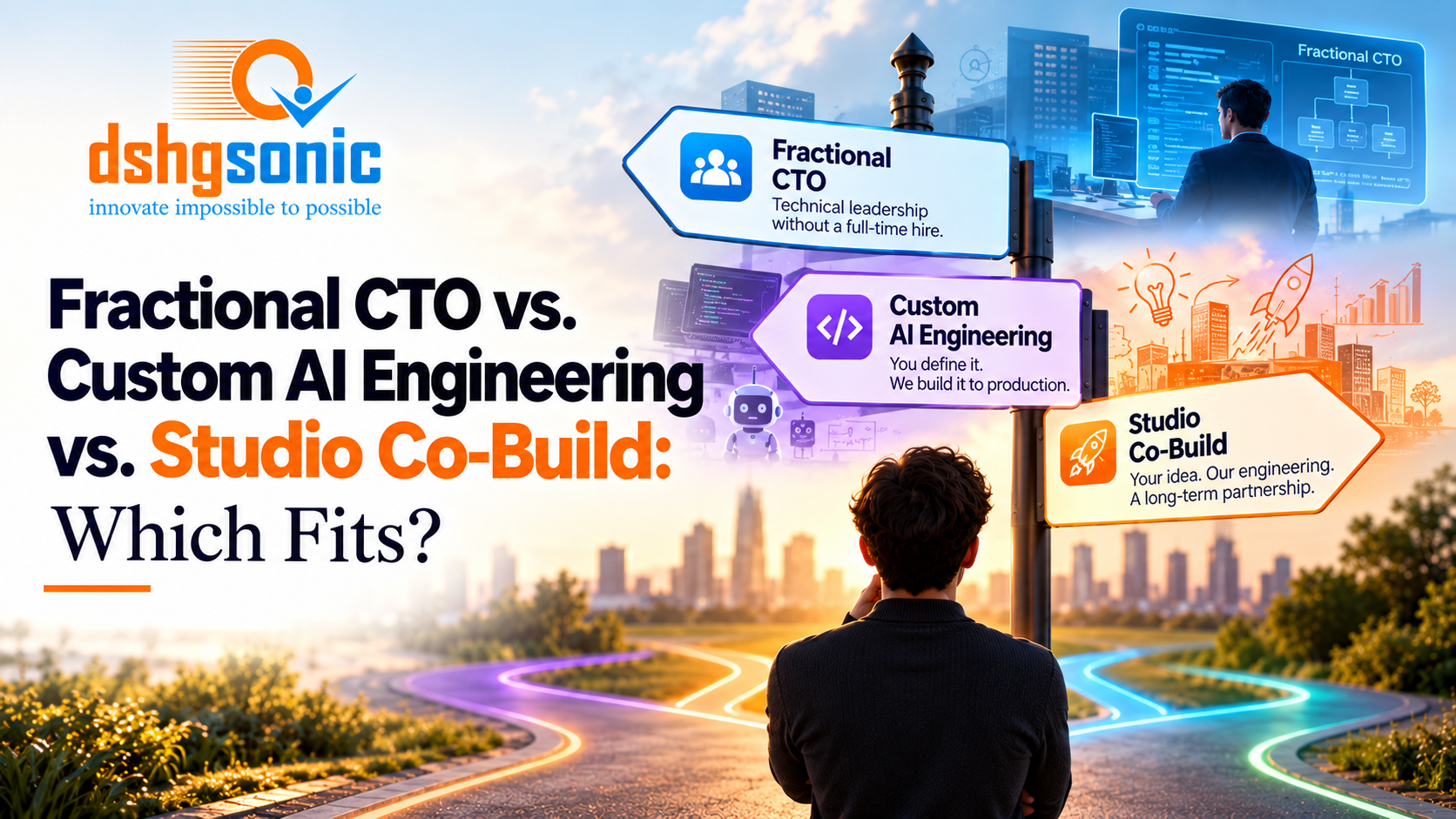
Fractional CTO vs. Custom AI Engineering vs. Studio Co-Build

Manish Balakrishnan
Manish is the Founder and CEO of DSHG Sonic and specializes in helping founders validate startup ideas through market research, customer discovery, and strategic analysis. He believes that strong validation is the foundation of successful startups and guides entrepreneurs in identifying product-market fit before scaling.
"Compare Fractional CTO support, custom AI engineering, and startup studio co-building by cost structure, ownership, scope, and stage."
A founder says, “We need a technical person.” A growing company says, “We need AI.” A funded startup says, “Our team can build, but we need someone senior to make the right architecture decisions.”
Those statements sound similar, but they describe three very different needs.
One may call for a Fractional CTO: senior technical leadership without a full-time executive hire. Another may call for custom AI engineering: a team that designs and builds a specific system. A third may call for a studio co-build: a deeper startup partnership that combines product, engineering, and long-term alignment.
Choosing the wrong category creates predictable problems. You can hire a strategist when you actually need builders. You can hire builders without anyone owning the technical direction. Or you can give away equity for work that should have been a straightforward commercial project.
This guide explains how the three paths differ, how pricing is typically structured, and how to decide which one fits your stage.
Quick answer
Use a Fractional CTO when your main gap is senior technical judgment, architecture, roadmap ownership, engineering leadership, vendor evaluation, or AI governance. Use custom AI engineering when you know the business or product problem and need a team to design and build the system. Use a studio co-build when you are an early-stage founder looking for a technical partner to help shape and build the company, often with a cash + equity structure.
The key distinction is simple: leadership, execution, or venture partnership.
What is a Fractional CTO?
A Fractional CTO is a senior technology leader who works with a company on a part-time or embedded basis instead of joining as a full-time executive.
The role can include technical strategy, architecture, product planning, engineering management, hiring, vendor selection, security decisions, infrastructure, AI strategy, and translating business priorities into technical decisions.
The word “fractional” describes time commitment, not seniority. A strong Fractional CTO should be capable of making the same kinds of decisions a full-time CTO would make, but the company uses only the amount of leadership it currently needs.
This is especially useful when a company has developers but lacks senior direction. The developers may be perfectly capable of writing code while still needing someone to decide what should be built, how systems should fit together, what technical debt is acceptable, and which decisions will become expensive later.
What does a Fractional CTO cost in 2026?
Published 2026 pricing guides show a wide market range because “Fractional CTO” can mean anything from a few advisory hours to embedded leadership. Fractional Pulse, which says its dataset includes 31 qualified CTO listings, reports hourly evidence in roughly the $200-$600 range, while noting that its hourly sample is limited. Other current market guides commonly place experienced operators around $150-$350 per hour, with monthly retainers often reaching several thousand dollars or more depending on commitment and specialization.
Those figures should be treated as market context, not a quote from DSHG Sonic. The more important point is why the range is so wide: scope changes the job. Five hours of architecture advice is not the same engagement as owning engineering decisions, attending leadership meetings, managing developers, reviewing AI systems, and being accountable for delivery.
When comparing Fractional CTO proposals, compare responsibilities before comparing rates.
When Fractional CTO is the right choice
Fractional CTO support is a strong fit when you already have some execution capacity but need better technical decisions.
You may have an internal engineering team that needs leadership. You may be a nontechnical founder managing an outsourced team. You may be preparing to hire a full-time CTO but need experienced leadership now. You may be entering a high-risk architecture phase, integrating AI into an existing product, or trying to control a growing collection of vendors and tools.
It is also useful when AI adoption is moving faster than the organization’s governance. Companies are increasingly using multiple models, agents, automations, and third-party AI services. Someone needs to decide where human review is required, what data can be sent to which system, how failures are logged, and when an agent should be paused rather than allowed to continue.
That is leadership work, not simply development.
What is custom AI engineering?
Custom AI engineering is execution around a defined technical or business problem.
The work may involve LLM applications, AI agents, copilots, retrieval systems, document processing, voice systems, workflow automation, computer vision, data pipelines, model orchestration, or integrations between AI and existing software.
The important word is “custom.” The goal is not to install AI because AI is fashionable. The goal is to build a system around the company’s actual workflow, data, users, constraints, and measurable outcome.
For a home-services company, that might mean an AI receptionist connected to lead follow-up and scheduling. For a healthcare platform, it might mean a carefully governed workflow that summarizes information without allowing the model to make unsupported clinical claims. For a SaaS product, it might mean an AI layer added to an existing application.
The engineering team owns implementation. Depending on the engagement, it may also own architecture and product decisions, but the center of gravity is building.
When custom AI engineering is the right choice
Choose custom AI engineering when the question is not “Who should lead our technology function?” but “Can you build this system?”
You should be able to describe the problem, users, current workflow, desired outcome, and constraints with reasonable clarity. Discovery can still be part of the engagement, but there is a concrete implementation target.
The biggest mistake is buying a generic AI demo. A successful system has to survive real operations: authentication, permissions, edge cases, model failures, logging, human review, latency, cost, data privacy, integrations, and the ordinary software engineering that surrounds the model.
What is a studio co-build?
A studio co-build is a deeper relationship with an early-stage founder.
Instead of receiving a specification and building it as a vendor, the studio participates in shaping the product and company. That can include MVP definition, architecture, product design, engineering, AI strategy, launch, iteration, technical operations, and continued support after the first version is live.
At DSHG Sonic, selected startup co-builds can use a cash + equity structure. The equity component is intended to create long-term alignment, not merely reduce an invoice.
That means a studio co-build should be evaluated differently from an agency quote. The founder is choosing a technical partner with exposure to the venture’s future. The studio is choosing which companies are worth taking venture risk on.
When a studio co-build is the right choice
A co-build is most relevant when the founder has a meaningful problem and business thesis but does not yet have a complete technical organization.
The founder may need help turning the idea into a buildable MVP, deciding what not to build, selecting the right architecture, launching quickly, and continuing through early product learning.
It is less appropriate when the company already has a mature engineering organization and simply needs additional capacity. In that case, custom engineering or Fractional CTO support is usually cleaner.
It is also less appropriate when the work is purely transactional. If you need one integration or one feature, equity is usually unnecessary.
Cost: why the three paths should not be compared like identical quotes
The pricing structures differ because the jobs differ.
Fractional CTO work is commonly priced as a monthly retainer or advisory commitment. Custom AI engineering may be fixed-fee, milestone-based, or retained depending on scope. Studio co-building may combine cash and equity because the relationship includes venture risk and longer-term alignment.
This is why asking “Which one is cheapest?” can be misleading.
If you hire custom developers but nobody owns architecture, the apparent savings can disappear in rework. If you hire a Fractional CTO but have no team capable of executing the roadmap, you may pay for excellent advice that moves slowly. If you use equity for a project that could have been purchased with cash, the long-term cost may be unnecessarily high.
Price the job you actually need.
A simple comparison
A Fractional CTO primarily owns decisions. Custom AI engineering primarily owns implementation. A studio co-build shares more of the company-building journey.
There is overlap. A Fractional CTO may review code. An AI engineering team may provide architecture. A studio may provide both leadership and execution. The distinction is the center of responsibility.
Ask: if this engagement succeeds, what will be different?
With Fractional CTO support, the company should make better technical decisions and operate its engineering function more effectively.
With custom AI engineering, a working system should exist and perform the intended workflow.
With a studio co-build, a founder should move from idea toward a functioning venture with a technical partner aligned beyond a single deliverable.
Can you combine the paths?
Yes, and many companies should.
A funded startup may begin with a Fractional CTO engagement to stabilize architecture and roadmap decisions, then add a custom AI engineering pod to execute the highest-priority work.
A founder may begin with a studio co-build, then move into a more conventional retainer after funding.
A growing business may start with a fixed AI engineering project, then retain senior technical leadership as automation expands across the organization.
The categories are useful for choosing the starting relationship. They do not need to become organizational walls.
How to choose in five questions
First, do you already have developers who can execute? If yes, but leadership is missing, start by evaluating Fractional CTO support.
Second, can you define the system you need built? If yes, custom AI engineering may be the most direct path.
Third, are you an early-stage founder looking for a technical co-builder rather than a vendor? If yes, evaluate a studio co-build.
Fourth, do you need both leadership and execution? If yes, choose a partner capable of combining them and make the responsibilities explicit.
Fifth, what are you willing to trade: cash, equity, time, control, or flexibility? Every engagement model allocates those differently.
What should a Fractional CTO actually deliver?
The output should not be a calendar full of meetings.
Depending on the company, useful deliverables may include an architecture roadmap, engineering priorities, technical hiring plan, security decisions, AI governance rules, vendor strategy, infrastructure plan, code-quality standards, release process, or direct leadership of the existing team.
The Fractional CTO should reduce uncertainty and increase the quality and speed of technical decisions.
What should custom AI engineering actually deliver?
It should deliver a production-minded system, not only a prompt.
That includes the surrounding software required to make AI reliable: data flow, permissions, validation, logging, fallbacks, evaluation, observability, human escalation, cost controls, and integration with the systems employees already use.
The model is one component. The business system is the product.
What should a studio co-build actually deliver?
A co-build should move the company toward a testable business, not merely a larger feature list.
The first version should be scoped around what needs to be learned. Product decisions should connect to the customer and business thesis. Engineering choices should support speed without creating avoidable traps. After launch, the team should be able to observe what users do and decide what deserves the next investment.
That is why the relationship is closer to company building than outsourcing.
Final takeaway
Fractional CTO, custom AI engineering, and studio co-build are three answers to three different questions.
Who should lead our technical decisions? Fractional CTO.
Who should build this AI system? Custom AI engineering.
Who can help us turn this early-stage idea into a real product and company? Studio co-build.
DSHG Sonic supports all three paths because companies arrive at different stages. The most useful first conversation is not about a service label. It is about the gap between where you are now and what must become true next.
Frequently asked questions
How much does a Fractional CTO cost? Current 2026 market guides show broad ranges, often from roughly $150-$350 per hour and several thousand dollars per month, with higher figures for deeper embedded leadership. Scope matters more than the label.
Do I need a Fractional CTO if I already have developers? Possibly. Developers provide execution; a Fractional CTO can provide senior architecture, roadmap, hiring, governance, and leadership.
Is a studio co-build the same as hiring an agency? No. A co-build is designed as a deeper startup partnership and may include cash + equity alignment.
Can DSHG Sonic provide both leadership and engineering? The studio model is designed to support technical strategy as well as product and AI engineering, depending on the engagement.
Sources for market-pricing context
Fractional Pulse — Fractional CTO Cost: 2026 Pricing Guide
Financial Times — The executives going 'fractional', not freelance