
Fixed Fee vs. Retainer vs. Equity: Which Fits?

Manish Balakrishnan
Manish is the Founder and CEO of DSHG Sonic and specializes in helping founders validate startup ideas through market research, customer discovery, and strategic analysis. He believes that strong validation is the foundation of successful startups and guides entrepreneurs in identifying product-market fit before scaling.
"Compare fixed-fee, retainer, cash + equity, and outcome-based technology engagements to choose the model that best fits your scope, stage, risk, and goals."
Choosing a technology partner is only half the decision. The other half is deciding how the relationship should be structured.
A startup founder building an MVP does not have the same needs as a growing company automating a revenue workflow. A funded product team that needs technical leadership is different again. Yet many software engagements are forced into the same commercial model: estimate the hours, agree on a price, build the thing, and hope the incentives stay aligned.
At DSHG Sonic, we use several engagement structures because different problems require different kinds of alignment. The four most common are fixed fee, retainer, cash + equity, and outcome-based. None is automatically “better.” The right model depends on how clearly the work can be defined, how much uncertainty exists, whether the relationship needs to continue after launch, and whether the value created can be measured.
This guide explains how each model works, when it fits, when it does not, and what founders and business operators should ask before choosing one.
Quick answer: which model should you choose?
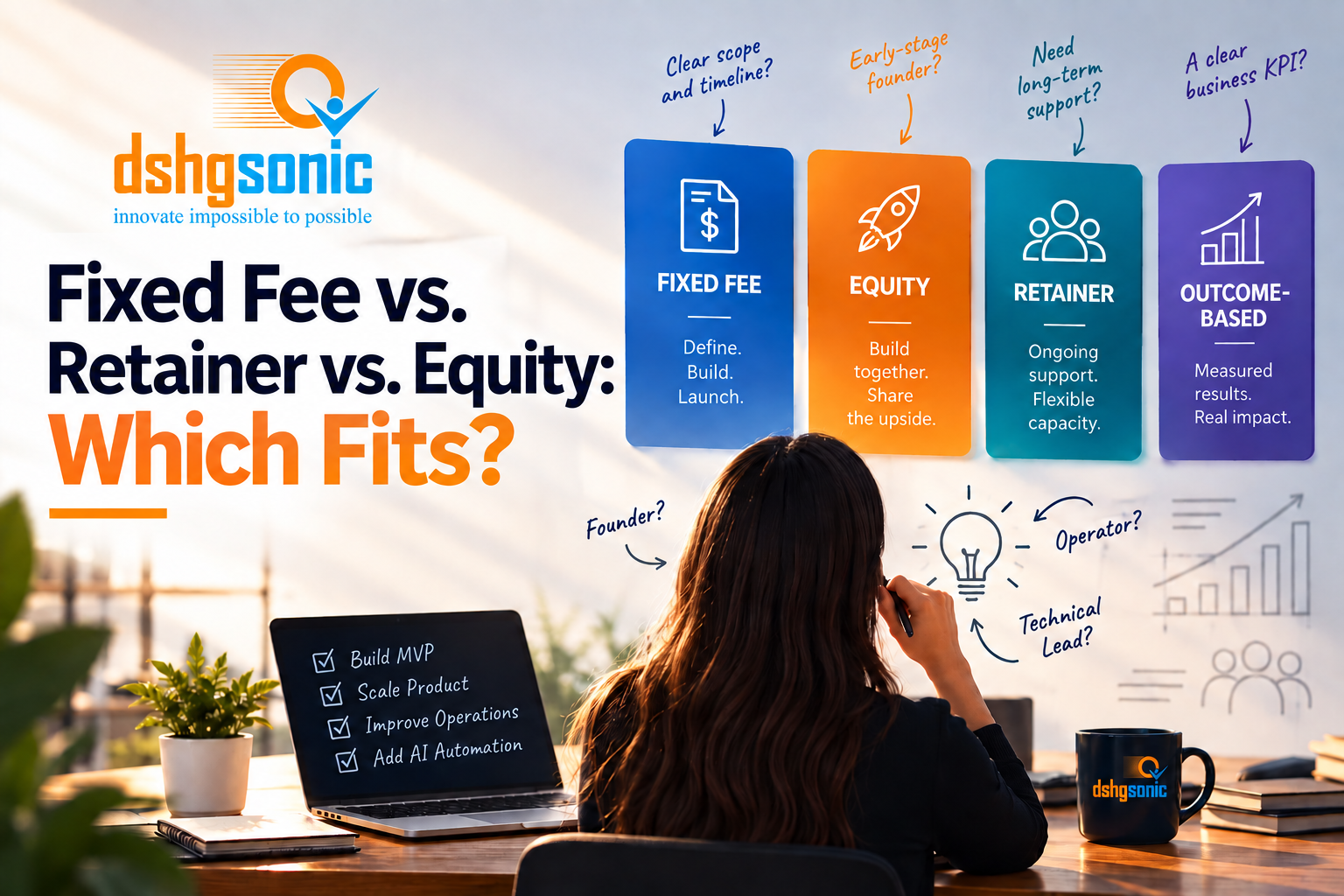
Choose a fixed-fee engagement when the deliverable and acceptance criteria can be defined before development begins. Choose a retainer when you need ongoing technical leadership, product iteration, or a flexible engineering capacity that changes month to month. Consider cash + equity when you are an early-stage founder looking for a technical co-builder whose incentives remain connected to the company after the first invoice. Consider an outcome-based model when the system is tied to a measurable business result such as recovered revenue, reduced labor, faster lead response, or lower operating cost.
The important question is not “Which model is cheapest?” It is “Which model makes both sides behave in the way this project needs?”
1. Fixed fee: best when the destination is clear
A fixed-fee project starts with a defined scope, timeline, deliverables, and price. Instead of paying for every hour used, the client pays for an agreed result.
This model works well for bounded product work: a defined MVP, a specific integration, an admin dashboard, a workflow automation, a mobile feature, an AI proof of concept, or a redesign with clear acceptance criteria.
The biggest advantage is budget clarity. A founder or operator can approve the project knowing what the initial build should cost. The studio also has an incentive to execute efficiently because unnecessary hours do not create additional revenue.
But fixed fee only works when the scope is truly definable. If the project begins with “we will figure out what the product is while building it,” a fixed price can create the wrong behavior. Either the vendor protects itself with a large contingency, or every new idea becomes a change request.
A good fixed-fee engagement therefore begins with specificity. What is being built? Which users are included? Which workflows are in scope? What integrations are required? What does “done” mean? Which assumptions could change the price?
At DSHG Sonic, fixed fee is generally the cleanest fit when the product or engineering outcome can be described before the build begins.
When fixed fee is a strong fit
Fixed fee is useful when you have a defined first release, a short list of core features, a known technical environment, and a deadline that matters. It can also work well for audits, architecture work, migrations, or clearly bounded AI engineering.
It is less useful when priorities will change weekly, when user feedback is expected to reshape the roadmap, or when the team is still discovering the business model.
2. Retainer: best when the work is continuous
A retainer buys ongoing access to a team or senior technical leader for an agreed monthly commitment. The goal is not to define every task months in advance. The goal is to create continuity.
This is often the right structure for a company that already has a product and needs continuous iteration, technical leadership, architecture decisions, AI implementation, engineering management, or a steady flow of product work.
A retainer is also a natural structure for Fractional CTO support. Technical leadership is rarely a one-time deliverable. Architecture changes. Vendors change. AI models change. Security issues appear. Developers need decisions. Product priorities move. A recurring relationship allows the technical leader to stay close enough to the company to make better decisions over time.
The risk with a retainer is vagueness. “Ongoing support” can become a bucket into which everything is thrown. A healthy retainer should still define the role, expected availability, decision rights, communication rhythm, and the kinds of work that are inside or outside the engagement.
The benefit is flexibility without restarting procurement every time the priority changes.
Retainer does not mean paying for inactivity
A well-designed retainer is not a subscription for vague access. It should create a predictable operating rhythm: roadmap reviews, architecture decisions, engineering leadership, sprint planning, product iteration, AI experimentation, or measurable operating improvements.
The value is continuity. The team does not need to relearn the product every month, and the client does not need to create a new statement of work for every new priority.
3. Cash + equity: best when you need a co-builder, not only a contractor
Cash + equity changes the relationship because part of the studio’s compensation is connected to the future value of the company.
For an early-stage founder, this can reduce the cash required for the initial build while giving the technical partner a reason to care about more than delivery. The studio has exposure to whether the product becomes a real company.
At DSHG Sonic, the cash + equity studio model is designed for selected startup engagements where there is enough alignment to justify taking venture risk. It is not simply a discount mechanism. Equity is valuable only if the company becomes valuable, which means both sides should treat the decision more like choosing a long-term partner than negotiating a coupon.
A founder should expect deeper diligence. Is the problem meaningful? Is there a plausible market? Is the founder committed? Can the first product be built within a sensible scope? Is there a path to customers, revenue, fundraising, or strategic value?
The founder should also ask what happens after launch. Does the studio disappear when version one ships, or can it continue supporting product, architecture, automation, fundraising readiness, and scaling?
Equity should buy alignment, not confusion
An equity component should never replace clarity about deliverables, ownership, responsibilities, or cash costs. The agreement still needs to define what is being built and what each side owns.
Equity works best when it creates aligned incentives on top of a professional operating relationship.
4. Outcome-based: best when the business result can be measured
Outcome-based work starts with a business number rather than a feature list.
For example, a home-services company may not actually need “an AI receptionist.” It may need fewer missed leads, faster follow-up, more booked jobs, and less administrative labor. A service business may not need “automation.” It may need to recover revenue currently leaking through slow response, manual quoting, repetitive scheduling, or disconnected systems.
When the baseline and result can be measured, the commercial model can be tied more closely to value.
That might mean a fee connected to savings, recovered revenue, qualified appointments, processing volume, or another agreed metric. The exact structure depends on what can be tracked reliably.
Outcome-based pricing is powerful because it forces everyone to define success. It also changes the conversation from “How many development hours did this take?” to “What did the system change in the business?”
But it is not appropriate for every project.
When outcome-based pricing does not work
Do not use outcome-based pricing when the outcome is mostly outside the technical partner’s control, when the baseline cannot be measured, or when attribution is impossible.
If a company wants an AI sales system but changes its pricing, ad spend, sales team, territory, and offer at the same time, it may be impossible to determine what created the result. The same is true when the client does not have reliable historical data.
In those situations, fixed fee or retainer is usually cleaner.
How to compare the four models
Think about four variables: scope certainty, relationship duration, risk sharing, and measurability.
Fixed fee has high scope certainty and low commercial ambiguity. Retainer has lower task certainty but higher relationship continuity. Cash + equity adds venture alignment and shared long-term risk. Outcome-based adds direct economic alignment when the result can be measured.
A founder building a first MVP might begin with cash + equity or fixed fee. A funded team that already has engineers may use a Fractional CTO retainer. A growing business trying to automate a specific operational bottleneck may start with fixed fee and later move to outcome-based once the baseline is measurable.
The model can also change over time. The first engagement does not have to be the permanent structure.
What about IP ownership?
IP ownership should be explicit regardless of the commercial model.
Paying with equity does not automatically mean the studio owns the product. Paying a fixed fee does not automatically answer questions about reusable frameworks, third-party libraries, pre-existing tools, or infrastructure.
The agreement should distinguish the client’s product-specific intellectual property from reusable studio tooling and third-party components. The important thing is that both sides understand the rules before development begins.
Does DSHG Sonic stay after launch?
It can, depending on the engagement.
Some projects are intentionally bounded: design, build, deploy, hand off. Others continue through product iteration, Fractional CTO support, AI automation, growth-stage engineering, or deeper operating-system work.
For a startup, the first launch is usually the beginning of learning, not the end of development. For a business automation project, the first workflow often reveals the next bottleneck. The commercial model should make it easy to continue when continued work creates value.
Can you switch models later?
Yes. In many cases, switching is healthier than forcing the original contract to handle a new stage.
A fixed-fee MVP can become a monthly retainer after launch. A retainer can become a defined project when the company wants to execute a major migration. A startup relationship can include cash + equity during the earliest stage and move toward standard commercial pricing after funding. An automation project can begin as fixed-fee implementation and become outcome-based after reliable measurement is in place.
The engagement model should reflect the current problem, not the history of the relationship.
A practical decision framework
Before signing, answer five questions.
First, can we define the deliverable precisely today? If yes, fixed fee deserves serious consideration.
Second, will priorities change continuously? If yes, a retainer may be more realistic.
Third, are we building a venture together and willing to share long-term risk? If yes, cash + equity may create stronger alignment.
Fourth, can we measure the economic result and attribute it fairly? If yes, outcome-based pricing may be possible.
Fifth, what happens after the first milestone? A model that works for launch may not work for scale.
The best commercial structure is the one that makes the incentives match the work.
The mistake to avoid: choosing by headline price alone
A lower quote is not automatically lower cost.
A cheap fixed-fee build that cannot adapt may create expensive rework. A retainer that lacks priorities can become wasted capacity. Giving away equity to save a small amount of cash can be costly if the company succeeds. An outcome-based agreement with poor measurement can create arguments instead of alignment.
Compare what each model asks both sides to do.
Who carries scope risk? Who carries execution risk? Who carries venture risk? What happens when priorities change? How is success measured? What happens after launch?
Those questions reveal more than the monthly number.
Final takeaway
Fixed fee, retainer, cash + equity, and outcome-based engagements solve different problems.
Fixed fee works when the destination is clear. Retainer works when the relationship and priorities need to stay flexible. Cash + equity works when a founder and studio are intentionally sharing venture risk. Outcome-based works when technology can be connected to a measurable business result.
DSHG Sonic uses multiple models because founders, businesses, and funded teams do not arrive with the same needs. The goal is not to force every client into one contract structure. It is to choose a structure that creates clarity, accountability, and aligned incentives from the first build through whatever comes next.
Frequently asked questions
Which model is best for an MVP? A well-defined MVP can fit fixed fee. A selected early-stage startup may also fit a cash + equity co-build when both sides want a longer-term relationship.
Which model is best for ongoing technical leadership? A retainer is usually the cleanest structure for Fractional CTO work and continuous product or engineering leadership.
Can outcome-based pricing be used for AI automation? Yes, when there is a reliable baseline and a measurable result such as reduced labor, recovered revenue, faster response, or increased conversion.
Can the engagement model change later? Yes. Many healthy relationships change structure as the company moves from discovery to build, launch, and scale.
To explore the related DSHG Sonic capabilities, see , commercial models, services, startup co-builds, AI systems.